Rinca vs Komodo: I Spent 10 Years Visiting Both — Here’s Why I’d Choose Rinca
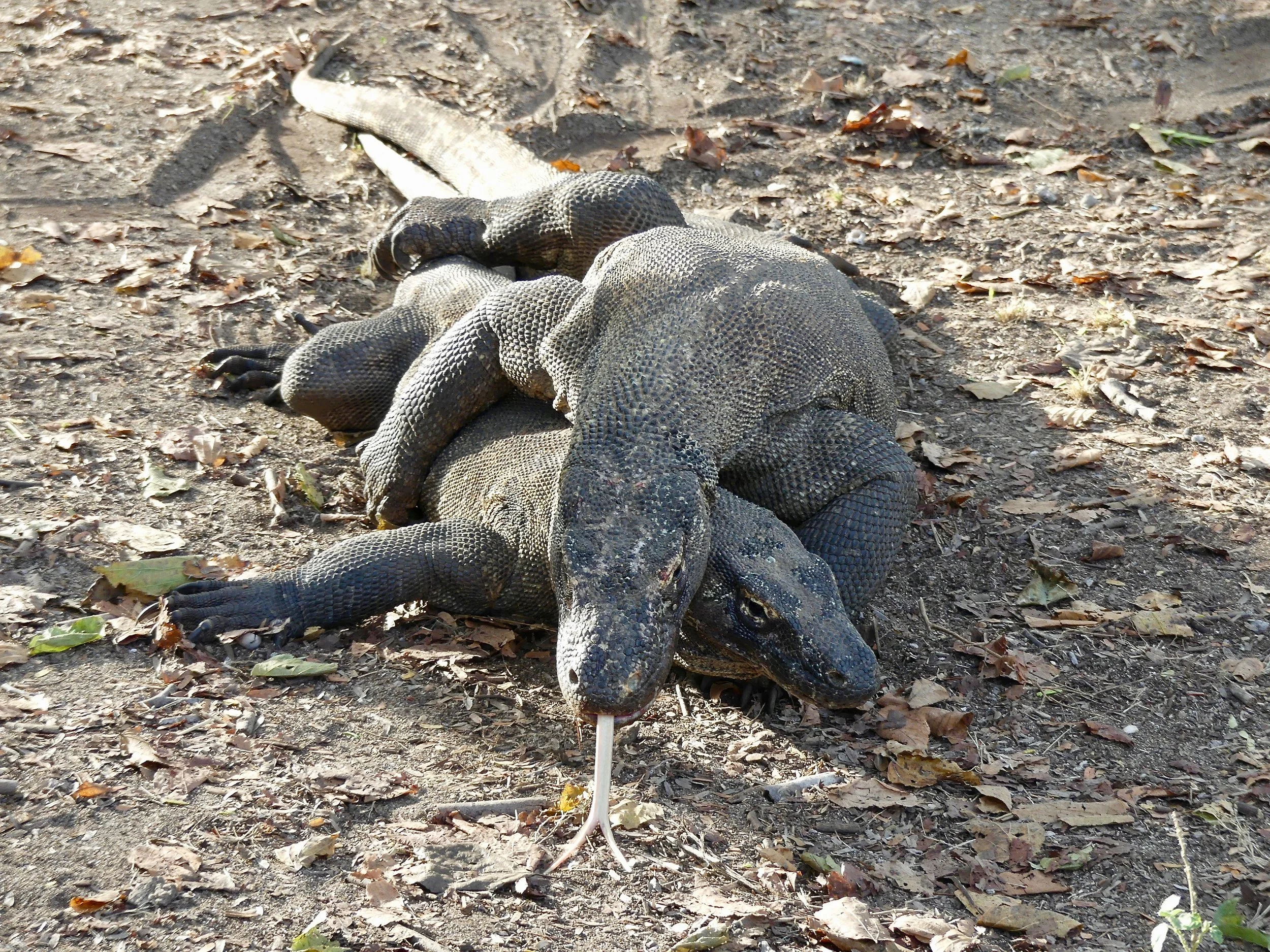
This might be a controversial opinion considering the animal is literally called the Komodo dragon, but if you gave me the choice between seeing them on Komodo Island or Rinca, I would pick Rinca every single time.
And this isn't based on one great day on Rinca and one disastrous morning on Komodo.
From 2014 to 2024, I visited both Loh Buaya on Rinca and Loh Liang on Komodo roughly once a week during the May to August cruising season. Most of those visits were while I was working aboard yachts and taking guests into Komodo National Park — a place that has given me plenty of Komodo National Park memories over the years — although I've also been to both a few times as an actual guest — which is much more relaxing when somebody else gets to worry about tickets, timing and whether everyone has remembered their water bottle.
I went back to Loh Liang again in May 2026.
I still prefer Rinca.
Not because the dragons are somehow better there. Not because Komodo Island isn't worth visiting. And definitely not because I want a national park turned into some immaculate tourist attraction.
I just think Loh Buaya does a much better job of managing the slightly awkward relationship between wildlife and the very large number of humans who want to come and stare at it.
And, perhaps even more controversially, I think some of the infrastructure people criticised so heavily on Rinca is exactly why it works.
First: Rinca and Komodo offer the same basic experience
When travellers ask whether they should visit Rinca or Komodo, what they're usually comparing are two visitor areas inside Komodo National Park:
Loh Buaya on Rinca Island and Loh Liang on Komodo Island.
Both are places where you can see Komodo dragons in the wild with a ranger.
Both offer proper ground-level trekking.
I want to emphasise that last bit because Rinca is sometimes described as if you arrive, walk around on an elevated boardwalk, look down at a dragon and leave.
That isn't how it works.
At Loh Buaya, the elevated walkway takes you from the arrival area to the ranger station. Once you get there, you go through a small gate with your ranger and start the actual trek on the ground.
From there, you're walking through the same kind of dry forest, savannah and dragon habitat you came to see in the first place.
There are different trekking routes depending on how far you want to walk. During my visits, we would choose between shorter, medium and longer routes depending on the guests, the heat and how optimistic everyone was feeling about walking around under the Flores sun.
So choosing Rinca does not mean sacrificing a proper trek.
What changes is how visitors are managed before that trek begins.
And that, for me, makes a huge difference.
Why I prefer Rinca
The arrival actually makes sense
You arrive at Loh Buaya by boat and step onto a floating dock before following a defined elevated walkway towards the ranger station.
It sounds like a small thing until you've spent years taking groups into wildlife areas.
People don't scatter everywhere.
Nobody is randomly wandering through the same space as animals because they're not quite sure where they're supposed to go.
The route is clear, organised and separated from the habitat below.
Along the way there are information panels explaining Komodo dragons, their environment and the wildlife around you. By the time you reach the ranger station, you've already learned something instead of immediately stepping off the boat and asking:
“So where's the dragon?”
And importantly, the elevated walkway wasn't just designed to make things easier for tourists.
It was deliberately built above ground so Komodo dragons and other animals could still move beneath it without visitors getting in the way.
It was deliberately built above ground so Komodo dragons and other animals could still move beneath it without visitors getting in the way.
That is one of those bits of tourism infrastructure that, to me, simply makes sense.
Rinca actually teaches you something
I also really like the information centre at Loh Buaya.
Inside, there are Komodo dragon skeletons and displays about the animals and the park.
For me, this matters.
Seeing a dragon is obviously the main event, but it is much more interesting when you understand what you're actually looking at.
These aren't just massive lizards conveniently standing around for photos.
The signs, museum and displays give you some context before you head out walking, and I think that makes the whole experience feel more like visiting a national park and less like ticking off the “saw Komodo dragon” section of an itinerary.
My experience with the Rinca rangers was consistently better
This is personal experience, but after years of visiting both sites, the difference was noticeable.
I consistently found the rangers on Rinca friendlier, more helpful and more enthusiastic.
They would explain the different trekking options properly. If guests wanted a shorter route, fine. If they wanted to walk further, there were longer options.
They followed the rules, kept the group together and, in my experience, generally seemed interested in actually doing the walk with you.
That shouldn't sound remarkable.
Unfortunately, after enough visits to Loh Liang, it did.
My problem with Loh Liang wasn't one bad morning
I should make this very clear.
My frustration with the ranger situation on Komodo Island did not come from one ranger turning up late one morning and me holding a grudge for the next decade.
It happened repeatedly.
Early mornings were usually our preferred time. It was cooler, wildlife could be more active and, crucially, you had a better chance of getting ahead of the larger groups arriving later.
The difficult part was getting the rangers there.
On multiple occasions I arranged everything in advance and explained exactly what time we would arrive.
I offered to pay extra.
I even offered to send our yacht's tender to collect them from their village, which was only around half an hour away by boat.
And they would still come late.
One incident in particular was the final straw.
I had a large group and, under the ranger ratio we were operating with at the time, I needed five rangers.
So I arranged everything the day before.
Seven o'clock.
At the dock.
Five rangers.
Very clear.
Seven o'clock came.
No rangers.
Eventually I had to find other rangers who happened to be around and pay extra just so I could get my guests moving.
The ranger I'd arranged finally arrived around 8 a.m. and explained that the boat from his village had been late.
Now, I have spent enough of my life travelling around Indonesian islands to understand that boats are occasionally late.
Time becomes a slightly philosophical concept once enough water is involved.
But this wasn't an isolated problem.
We had tried early starts repeatedly. I had offered extra money. I had offered transport. I had planned ahead.
At some point, when you're responsible for a group of paying guests, you stop wanting to gamble the first hour of their day on whether somebody is going to turn up.
So I stopped bringing my guests to Loh Liang.
And then there's the jetty
Loh Liang's arrival has always baffled me.
There is this enormous jetty built to accommodate much larger vessels, and somehow the whole thing manages to feel far less welcoming than the much more organised arrival on Rinca.
At low tide, depending on where you're getting off, you can end up making your way across the beach or through shallow water before you've even started the trek.
Nothing improves a hot, dusty walk quite like beginning it with wet shoes.
And before anyone tells me this is outdated information from my yacht-working days: I went back to Loh Liang in May 2026, this time as a guest rather than the person responsible for everybody else's day.
The infrastructure was still essentially the same.
Absence had not made the jetty more charming.
Around 60 stalls aren't the problem. How they're organised is.
There is also a substantial commercial area around Loh Liang.
From memory, there are roughly 60 stalls, mostly selling souvenirs, with some selling drinks and other things visitors might want.
And I want to be very clear here:
I am not against the stalls.
Not at all.
Tourism brings a lot of money into Komodo National Park, and local communities absolutely should benefit from that.
People should be able to sell souvenirs and drinks.
My issue is how all of that activity is organised.
This is the habitat of an animal that exists in very few places on Earth.
If dozens of stalls are going to operate inside that environment, then the layout, waste management and visitor movement should be designed around reducing disturbance as much as possible.
This is exactly why I agree with the concept at Rinca.
The issue isn't development versus no development.
Tourism infrastructure already exists in both places.
The question is whether it is thoughtfully organised.
At Loh Buaya, visitors arrive, follow a defined elevated route, reach the ranger station, and then enter the trekking area with their ranger.
Human movement is concentrated in specific places rather than casually spilling everywhere.
To me, that makes far more sense than pretending that rows of stalls, a giant jetty and large numbers of people moving around the visitor area somehow count as the more “natural” option.
Then add a cruise ship to the equation
This is where Loh Liang can become especially frustrating.
Large cruise ships visit Komodo Island, and when one is anchored offshore, the atmosphere can change very quickly.
Suddenly, you're not sharing the ranger station and trails with a few other boats.
You're dealing with large organised groups arriving at roughly the same time, all of whom understandably also want a ranger, a trek and their photograph with a dragon.
If your idea of the morning was a quiet wildlife walk, this is not ideal.
Obviously, not every day on Komodo is a cruise-ship day.
I've had quiet visits there too.
But if you're actually choosing between Loh Liang and Loh Buaya rather than simply following a fixed itinerary, this is one of the reasons I tend to choose Rinca.
I once watched Komodo dragons moving through plastic waste
This is still one of the things I remember most clearly about Loh Liang, even though I wish I didn't.
It happened sometime before Covid, near the far end of the main jetty around where the old ranger kitchen used to be.
There was rubbish scattered and gathered across the ground — plastic packaging, bottles and other waste — right in an area the dragons were moving through.
I filmed it at the time.
[Embed video here: Komodo dragons moving through plastic waste at Loh Liang.]
Watching these animals walking around and foraging among our rubbish was just... messed up.
There isn't really a more elegant way I want to put it.
And to be fair, waste is not exclusively a Loh Liang problem. Plastic pollution and waste management are much wider issues across Komodo National Park and the surrounding tourism industry.
But seeing it there in front of me made the contradiction impossible to ignore.
Here was this extraordinary animal — the reason everybody had travelled to the island in the first place — moving through a landscape we had covered in plastic.
For me, that is exactly why arguments about visitor infrastructure need more nuance than:
“Development bad. Untouched nature good.”
Badly managed tourism can disturb a place whether the infrastructure looks shiny and new or old and rustic.
What matters is how people, rubbish and visitor activity are actually managed.
Why I support the concept behind Rinca's redevelopment
The redevelopment of Loh Buaya was controversial.
And I understand why.
If you see photographs of major construction inside a national park, of course it makes you uncomfortable.
It should.
People should question large tourism developments inside important wildlife habitat.
Where I disagree is when the argument becomes:
Visible infrastructure must automatically be worse for nature.
I don't think it is that simple.
I once had a very long argument about Rinca's development with an environmentalist who, as far as I could establish, had never actually been to Loh Liang.
And that frustrated me.
Those of us who spent years operating in the area were seeing the practical problems on the ground.
We saw the visitor movement.
We saw the rubbish.
We saw the commercial areas.
We saw what happened when lots of boats arrived at the same time.
We saw how people and dragons ended up moving through the same spaces.
So when Loh Buaya created an elevated route that physically separated arriving visitors from wildlife movement, I didn't automatically see that as destroying the experience.
I saw the logic.
Most importantly, once you reach the ranger station, you're not trapped inside some elevated tourist bubble.
The gate opens.
You step onto the ground.
And off you go through Rinca with your ranger.
You still sweat.
You still walk through dry forest and open savannah.
You still peer under trees to see whether an enormous lizard is asleep in the shade.
You still need to listen when the ranger tells you where to stand.
The difference is that the chaotic part of getting large numbers of humans from boats into wildlife habitat has been organised.
I think that's a good thing.
So, should you skip Komodo Island completely?
No.
If your itinerary naturally includes Loh Liang, I wouldn't tell you not to go.
If you've spent years dreaming of physically setting foot on Komodo Island because you've been obsessed with dragons since you were eight, go.
I understand the appeal.
There is something undeniably satisfying about seeing a Komodo dragon on Komodo Island.
The naming alignment alone scratches a very particular part of the brain.
And if you arrive on a quiet day with a good ranger, you can absolutely have an enjoyable walk there.
I'm not saying Loh Liang is a terrible place where everybody has a miserable time.
I'm saying that after spending a decade repeatedly visiting both, and being responsible for taking other people there, I stopped choosing it.
Those are different things.
Rinca vs Komodo: which would I choose?
If a friend came to Flores tomorrow and told me they only had time for one dragon trek, my answer would be easy.
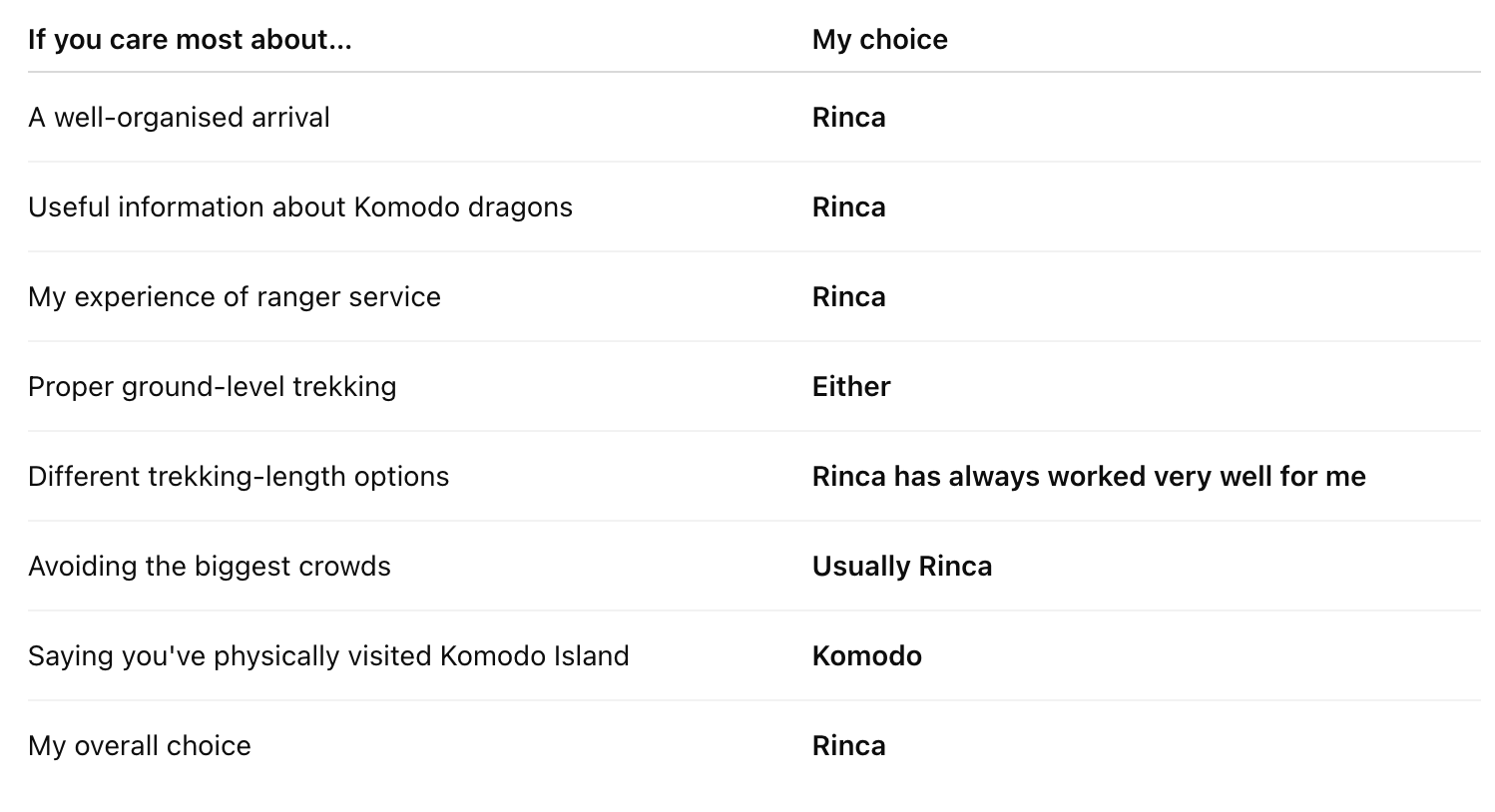
Rinca doesn't win for me because it has better dragons.
It wins because I think Loh Buaya does a much better job of managing the humans who come to see them.
And in a national park receiving huge amounts of tourism, that matters.
The dragons were there long before the docks, souvenir stalls, yachts, cruise ships, Instagram posts and all of us visitors arrived.
We're the ones who need organising.